Amin Khan - Game Developer

N.Deka:X (NDX) / Beta Arcade (2024)
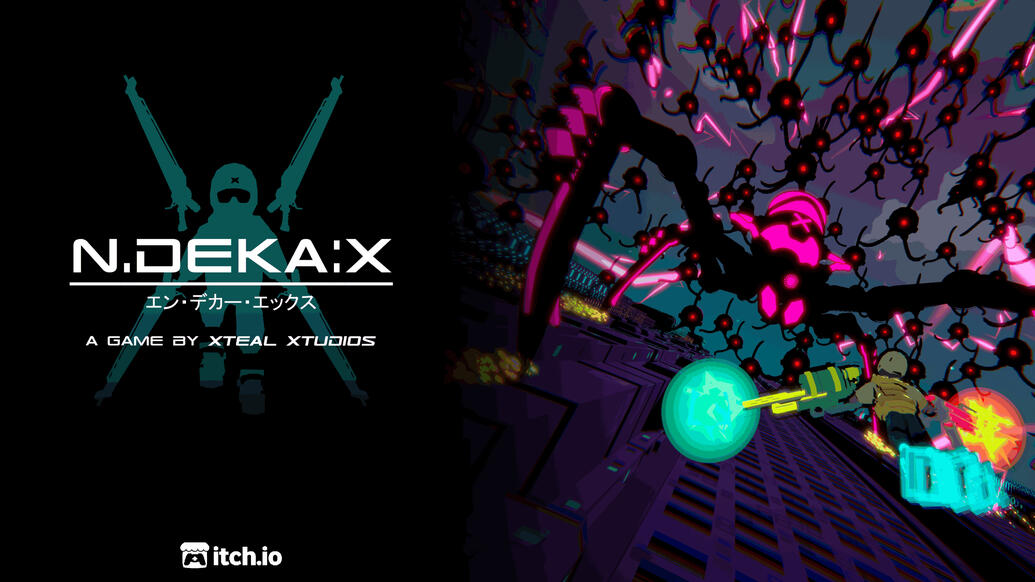
Here is the game that is by far the magnum opus of all projects I've worked on. Culminating all the game development skills I've acquired by making and playing shmups over the years, I along with a team of 10 were able to forge the ultimate arcade shooter project.N.Deka:X, named from éndeka (Greek for 11), deca- (Latin prefix for 10) and the Roman numeral X, was a project created in Unity for my final year Beta Arcade module at university, where we were tasked with developing a complete indie game with total creative freedom.NDX is a 'hybrid' bullet hell shooter game that shifts between a top-down twinstick shooter and a side-scrolling shoot-em-up, where the player has access to a wide variety of weapon types to take down enemies in different ways. Our ideas stemmed from the desire to create something thrilling and varied with a high focus on fun and stimulating gameplay.The concept of shifting perspectives was something we came up with when thinking about how to make a simple base game more engaging - so we thought up the idea for something that played in a simple 2D perspective but played with 3D camera shifting for more dynamic scenes.I was a main programmer throughout the project, and my involvement was to create core game systems in Unity. I aimed to do this by making these systems in a way to simplify content creation for the game - by this I mean I essentially made tools for implementing the game design. The core systems I made were:
The bullet hell system which managed the handling of hundreds of bullets for both enemies and the player, and included a tool that allowed for diverse customisation of firing patterns from Unity's inspector.
An enemy movement timeline and wave choreographer that was for implementing and scheduling the timing of elements during the level, plus a visual debugger displaying the trajectory of enemies.
The system for scripting boss battle attack patterns, which allowed us to view and edit boss behaviour without touching any code.
I also got the opportunity to work partly as a technical artist too, by communicating with the animators to implement their work into the game as well as creating certain visual elements - such as some VFX, boss animations for cutscenes, and our version of the iconic 'boss warning siren' found in the shmup genre.The final game has one long level filled with plenty of unique hand-crafted enemy waves, satisfyingly powerful weapons, and massive energetic boss battles.With massive inspiration from retro classics like Einhänder and Radiant Silvergun, NDX became a great representation of everything we were aiming for. I can't really think of how else to describe it. It's just sick as hell.
Crackin Inc Minigame Prototype Collection (2025)
A collection of rapid prototype WarioWare-style minigames with rough graphics developed in Unity during my time working with Crackin Inc in Tokyo. Our client for this project was TaiTan, a Japanese hip-hop artist who was aiming to create a digital version of an in-person immersive experience event he hosts. The game is still under development with full gameplay footage being NDA.I took lead of the minigame development during, rapidly prototyping up to 3 per day over a period of a week to quickly explore concepts. The idea behind their function was to be superimposed over a main 3D gameplay scene and completed to achieve a score-related goal, similar to a quick time event. To align with TaiTan's underground Shibuya-Punk aesthetic and the game's setting, the motif of the minigames were designed to be gritty and feature a rat character.The minigame interface system is fully encapsulated within a namespace and can be transferred over to other projects by simply exporting the content as a Unity package. Each game derives from a common parent class allowing them to be randomly 'shuffled' during the main game, and each child class has unique configurable parameters to adjust the difficulty levels - such as how many roads to cross, the accuracy of the metal detector, the size of the pachinko barrier, how many times the cups shuffle, etc.
Plasma Simulation (2024)
This was a third year project about programming physics simulations. I chose to implement a simulation of plasma-like matter within the Unity engine using C#, with the intent of developing it in the same way VFX programmers or technical artists would for films or games.The project demonstrates the use of the marching cubes algorithm to render isospheres, tuneable field equations to distort the isospheres based off their velocity, and a linked-particle fluid simulation to determine the rendering points.Part of this module also involved investigating the implementation of rigidbody physics, which I implemented with a sphere-plane collision demo.
NEO: The World Ends With You Combat System Re-creation (2022)
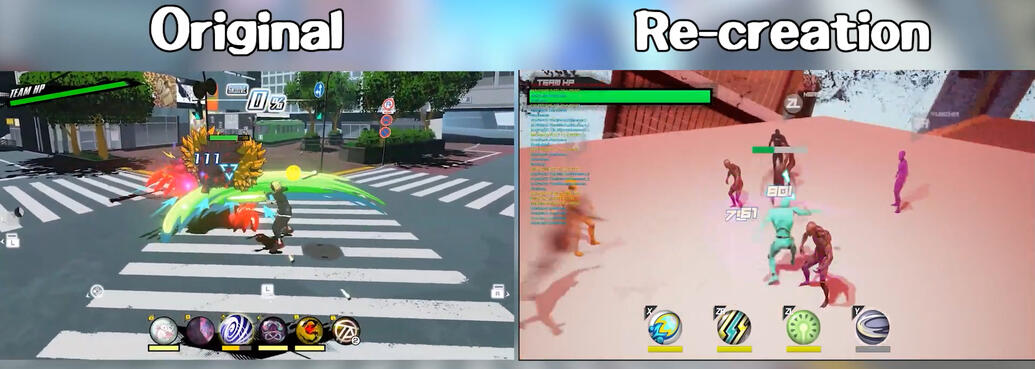
Footage in showreelFor my first Unreal Engine project at university, I remade the combat system from Square Enix’s recent JRPG, Neo: The World Ends With You. This was my first time making something with the engine and had to learn the Blueprint visual scripting language as I went.The demo closely recreates the third-person action combat of the original game, along with the equipable ability system where the player controls several party members simultaneously. This one university module alone gave me massive fluency in the engine because of the variety of features I needed to learn to make to complete this remake.
Hypercosmic Rebound (2021)
Hypercosmic Rebound was my final major project in college, where the objective was to plan out and execute the development of a small indie game in full. This included all stages of production, including research, pre-prod and post-prod.HCR is an arcade-style bullet-hell game inspired by games like Ikaruga and Touhou. The gameplay is similar to other games in the genre, but the unique selling point we planned was the 'parrying' system. The mechanic was designed to make the game more tense as it allowed us to design levels that encouraged our players to be risky.I acted as the lead for a team that was composed of freelancing artists who were also working with other teams. This meant my main development roles were as the main programmer and designer. It was important to manage my team and keep them organised, as well as being available to them if they required help or guidance.The final product is one of my favourite pieces of work as we managed to create a fully functional and polished experience that I can confidently show people, and also enjoy playing myself. It's even be added to a wiki page of free shmup games.
Hypercosmic Litewave (2022)

Footage in showreelHCLW was a small game made for the Game Engine Construction module in my second year of university. The objective was to write a custom game engine with C++, which involved programming low level code to render graphics.The end project was a flexible 2D game engine with extra features I designed specifically for making shoot-em-up games, such as collisions, sprite-sheet animators, object pooling, and xml level creation.
Project: WEB (2023)
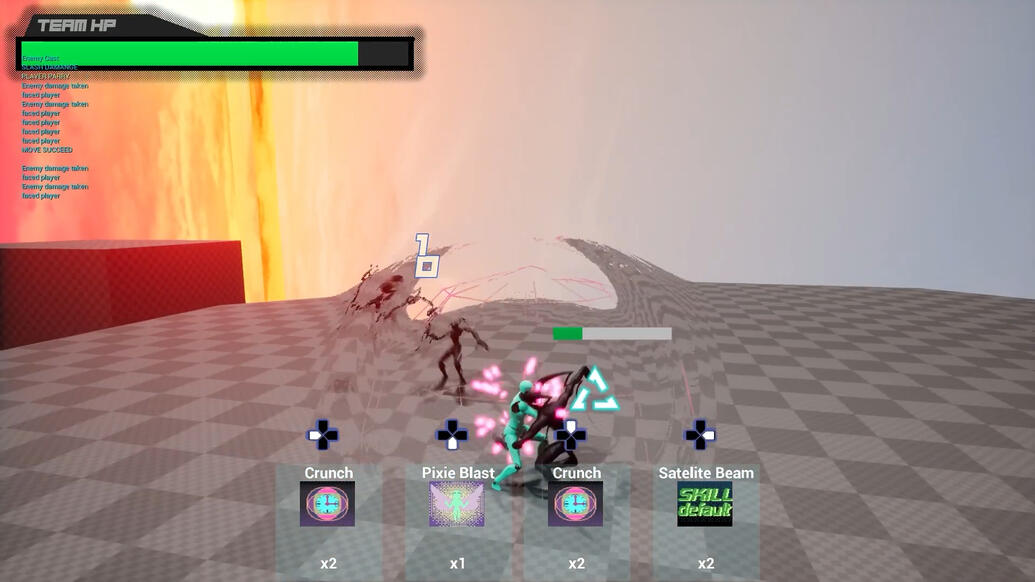
Footage in showreelProject: WEB is a personal project where I’ve been working on a prototype of a third-person action RPG game in Unreal Engine 4. The main goal is for me to design and program a unique combat system, including doing pre-production and research for the whole thing.The base combat is inspired by the Kingdom Hearts series and its ‘proximity-based combat’, where the player’s attacks depend on things like the location of the enemy, how many enemies are nearby, and their aerial state. It allows for slick, free-flowing gameplay that lets you perform a variety of sword attacks with just one button.One of the major parts of the project so far has been learning how to use motion capture to create the custom animations for the game. I did this by attending lectures and practical sessions from the animation course at my university in my free time, which gave me free hands-on experience operating a mocap studio. Once I'd learnt that and the post-capture digital clean-up process, I planned out the animation assets I'd need then scheduled a capture session. It was also a valuable experience directing my mocap actor's specific movements as it was similar to the role of a film director.
10 Zeptoseconds (2021)
This was another gamejam I worked on solo. This time the jam was hosted by Double 11 at my university, and I had a week to create a game around the theme of 'Out of Time'.I aimed to create a mechanically simple game that allowed me to focus more on designing more levels and polish the aesthetic of the game. The gameplay is essentially of a top-down puzzle game where you're limited to 10 seconds per level. The graphics are simple but I implemented plenty of visual effects to give a trippy vibe to the gameplay, overall making the product a juicy sensory experience.This project kicked off my philosophy of 'less is more' which I now follow when taking part in jams with a short time limit.In the results of the jam, my game ranked 1st in every category except for 'Innovation', in which it ranked 2nd.In 2022 this game won the Grads in Games 'Student Game (Solo)' award, presented by Futurlab (the developers of Powerwash Simulator). What's crazy is that I actually did not know I won this award since an old teacher of mine nominated the game without informing me, and I was not contacted or invited to the ceremony. The only reason I knew I'd won was because a guy I knew just so happened to be at the ceremony in Sheffield. Mad situation.
Innards Exterminator (2021)

This was a solo project I worked on for a month-long gamejam where the theme was to make a boss-rush style game.I took inspiration from games with metroidvania-styled exploration as well as bullet hell games to make a ranged-combat platformer where you explore the inside of a giant humanoid creature. The focus of the game is the boss-fights against the organs of the creature, each of which I had a lot of fun designing and scripting cool attack patterns for. Since I was jamming solo I worked on a majority of the pixel art in this game, putting together a gross cartoony-gore-filled environment.In the results of the jam, IE got the #1 rank in creativity, #2 rank in graphics, and #3 rank overall.
FK Tentacle Simulation (2023)
Footage in showreelFor my Real-Time Simulation module in my 2nd year of university, I decided to program something related to technical art/animation, and did some research into inverse kinematics and forward kinematics.Using Unity (so I could focus on programming the system rather than arbitrary things like rendering), I made a script that can simulate the combined rotation of several joints in an appendage (without using Unity's built in parenting system). To add more spice I implemented spring torsion and angular velocity to the joints to add twanging physics.I had also attempted to add inverse kinematics for this assignment but was unable to fully learn it in time, so it only works to a varying degree in the final project.I chose to do tentacles for this project because I thought it'd look cool.
About
I'm a Games Programming graduate from Teesside University, with a First-Class Bachelor of Science degree and an average module grade of around 85%. I specialise in high-level programming and engine development, with my best strength being Unity and C#, while also having a good amount of experience with other tools such as C++ and Unreal Engine.I've garnered a wide variety of projects on my portfolio since I began college, which includes artefacts developed for my studies and games created for more hobbyist activities (i.e. gamejams, self-teaching).I'm a strong advocate for creative expression, and therefore I'm passionate about creating games and other projects as an artform. One of my main goals is to act as a creative director.Professionally I've worked as an intern at Sports Interactive, the studio behind the Football Manager series. I've worked in various roles, starting with software engineering for their in-house game engine, and working towards technical animation with. Most recently I've helped with their next big game, Football Manager 25, the first game in their franchise to include female footballers in which I helped clean up the motion capture data for.I have experience working abroad at Crackin Inc, a game studio located in Tokyo, as a general gameplay programmer and VFX artist and animator. I've contributed to projects led by the producers of large IPs such as Ultraman and Shin-Ei Animation.Favourite games:
Disgaea; Ikaruga; Radiant Silvergun; VVVVVV; Chrono Trigger; The World Ends With You; Xenoblade Chronicles; Crypt of the Necrodancer
Qualifications
Teesside University (BSc Games Programming)First Year:
-Systems And Games Technology - 95%
-Visual Scripting (Unreal Engine) - 97%
-C++ Programming - 92%-Algorithms For Games - 96%
-Games Development With C++ - 96%
-Maths For Games - 97%Second Year:
-Real-Time Simulation - 84%
-3D Graphics Programming - 85%
-Games Engine Construction - 94%-Journeyman (cross discipline team project) - 81%
-Network And Multiplayer Gaming - 64%Third Year:
-Mobile And Gaming Devices - 81%
-Beta Arcade (cross discipline team project) - 87.4%
-Physics Simulation - 89%-AI For Games Engines - 82%
-Games Programming Project - 87%